
The Lutheran Highlands Seminary, Ogelbeng (near Mt Hagen city, ELC-Hagen district) is one of ELCPNG’s key training institutions for pastors and church workers, and is also recognised as one of the early centres of Lutheran mission work in the Highlands, dating back to the 1930s. It is one of ELCPNG’s three main seminaries producing clergy for the Church, alongside Senior Flierl Seminary (SFS) at Logaweng, Finschhafen, and Martin Luther Seminary (MLS) in Lae.
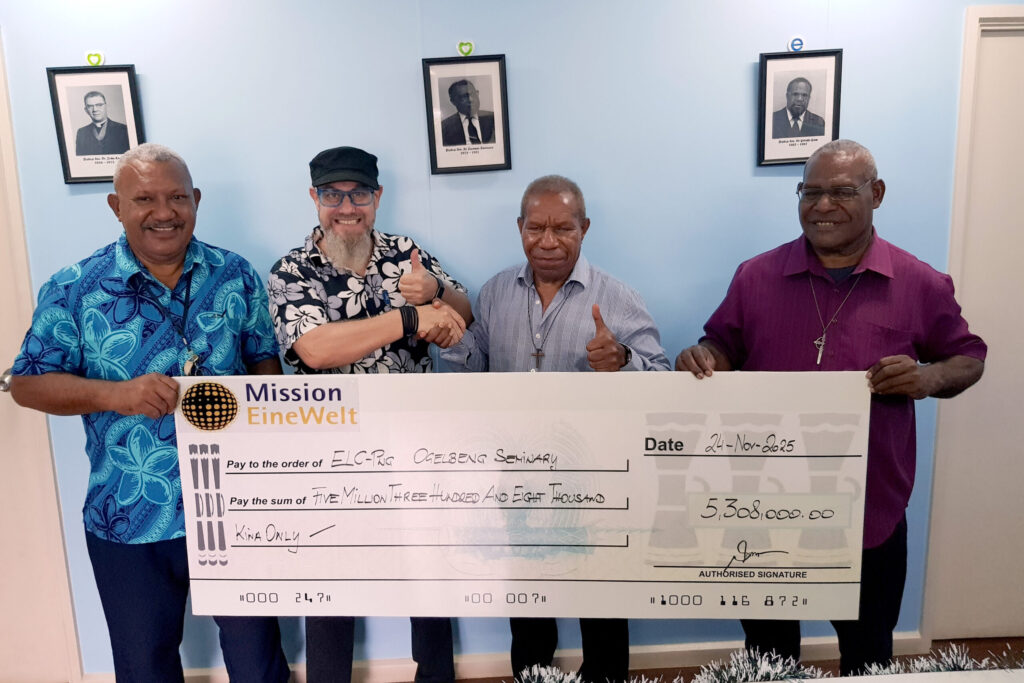
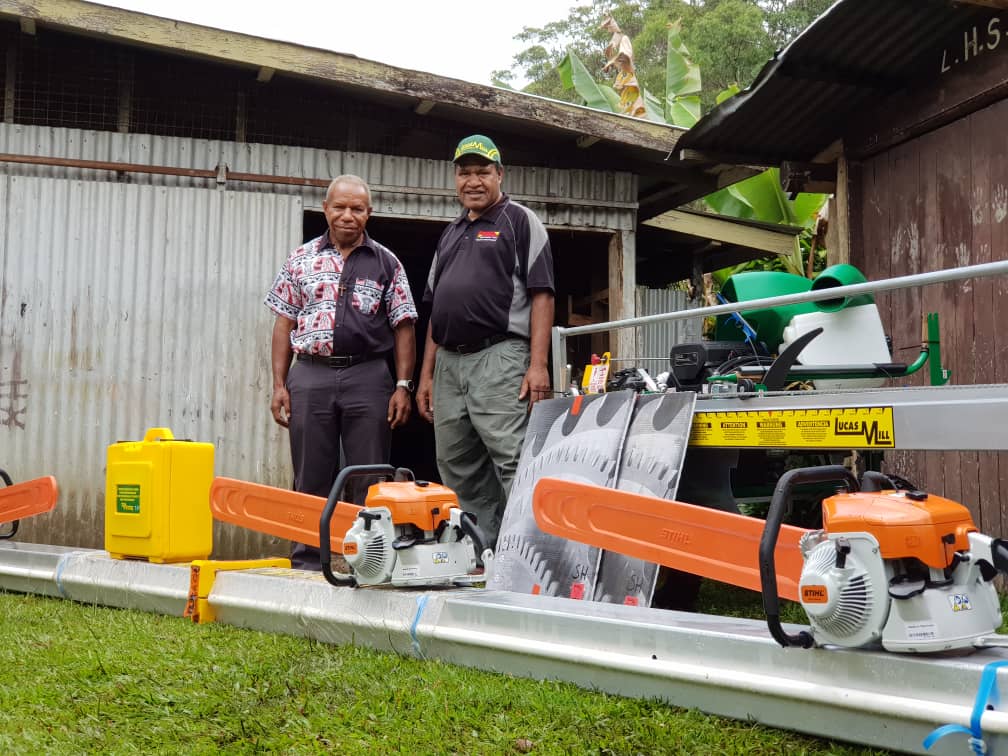
A major renovation project at Ogelbeng Seminary is scheduled to commence in early 2026 and is expected to continue through to the end of 2026. The project is primarily funded through a donation from the Evangelical Lutheran Church of Bavaria (ELCB). ELCB has contributed a total of PGK 5.3 million toward the renovation works. In addition, ELCB has supported the seminary by procuring a school truck, a sawmill, and chainsaws to enable in-house production of school furniture.
On 17 December 2025, at Ampo, a ceremonial cheque representing the full project amount was formally presented to the Church Executive, comprising Rev. Dr. Jack Urame (Head Bishop), Rev. Lukas Kedabing (Assistant Bishop), and Bernard Kaisom (General Secretary), by Mr Roland Kornhaeusl, Advisor to the ELC-PNG Project Management Office and Supervisor of the Overseas Personal Affairs Committee. The presentation marked the formal launch of the Ogelbeng Seminary renovation project.
ELCPNG Head Bishop Rev. Dr. Jack Urame thanked the ELCB for the support, saying seminaries are the heartbeat of the Church, training clergy and church workers to serve God’s people. He said Ogelbeng is a major training institution that has been neglected for a long time, and that the support is critical for strengthening pastoral ministry across the Church.
“For so long, Ogelbeng has not seen changes to its facilities,” Bishop Urame said. “What was built during the colonial and missionary days is still there.”
Rev. Dr. Jack Urame noted that the project evolved through an ongoing process of consultation with the partner church. This included his visit to Germany, continued communication, and a series of meetings with visiting partner representatives. Through this sustained engagement and collaboration, the initiative gradually developed into the comprehensive renovation plan now being implemented. He also expressed gratitude to other funders, both private individuals and institutions, who have supported all three theological training institutions over the years. He said their support has not gone unnoticed and gave thanks to God for their generosity and continued commitment.
Moreover, the renovation project reflects the long-standing partnership between the Evangelical Lutheran Church of Papua New Guinea (ELCPNG) and its strategic Lutheran partners overseas. These partnerships have been sustained over many years through a shared commitment to strengthening theological education and the training of future pastors. A key partner in this journey is Mission One World, together with related church partnership networks, which have consistently supported ELCPNG in pursuing these goals.
The partnership between ELCPNG and the Evangelical Lutheran Church of Bavaria (ELCB) and Mission One World dates back to 1886, marked by the arrival of pioneer missionaries from Bavaria. In the post–World War II and post-colonial period, additional partners from Australia, Germany, and the United States also supported mission and church development work in Papua New Guinea. Their contributions, ranging from pastoral and educational support to infrastructure development, continued until ELCPNG became an autonomous church in 1976.
Even in periods when partner churches were no longer directly engaged in field mission activities, they remained closely connected to ELCPNG through ongoing programs, scholarships, and infrastructure support. Rev. Dr. Jack Urame expressed his heartfelt gratitude to all Lutheran Overseas Partner Churches of ELCPNG for their faithful and enduring support over the decades.
Bishop Urame described the initiative as the first of its kind at this scale. While ELCPNG has long benefited from support from partner churches in Germany, Australia, and the United States, he noted that a major infrastructure project of this value for one training institution is unprecedented. He thanked all who have been involved since the initial consultations in Germany, including the office of Mission One World and the newly established ELCPNG Project Management Office (ELCPNG PMO) at Ampo, working together to bring the project to this stage. He said similar initiatives could also be developed with other partners now that this office is in place.
According to the ELC-PNG Project Management Office (PMO), the scope of work includes the installation of a 130,000-litre Southern Cross back-up water tank; the renovation of 32 duplex student accommodation units; improvements to kitchen facilities; renovation of the single men’s dormitories; construction of an ablution block; erection of a new canteen; extension and renovation of the office complex; establishment of 60 modular toilet systems; upgrades to showers and bathrooms; repainting of houses and roofs; and the construction of a timber shed, among other activities.
In addition, the entire electrical infrastructure of the institution will be renewed as part of a broader sustainability initiative. The seminary will transition towards renewable energy solutions, with a hybrid power system supported by solar installed for the administration facilities. Furthermore, solar street lights will be installed throughout the campus.
The school truck, Lucas sawmill, and Stihl chainsaws have already been procured and formally handed over to the management of the institution.
As the ELC-PNG Project Management Office continues to develop, additional major projects are expected to follow. These initiatives will focus on upgrading institutions and enhancing ELCPNG’s service delivery in the areas of education and health, as well as expanding access to sustainable energy solutions through hydropower and other alternative resources. Further community-focused projects, such as the development of funeral homes and memorial parks, are also envisaged.
These projects will be implemented in close cooperation with existing supporters and funders with whom ELCPNG has built long-standing partnerships, while also actively engaging new partners to collaborate with ELCPNG in the future.